Compare / Attribution (MMP)
AppsFlyer measures your ads. grovs runs your own channels.
AppsFlyer is a mobile measurement partner built around paid acquisition. grovs covers links, analytics and messaging for the channels you own, in your cloud.
Checked against AppsFlyer's public docs and pricing · 16 October 2026
grovs
Links, analytics, engagement, revenue, data
- Built for
- The channels you own, end to end
- Runs in
- Your cloud, or grovs Cloud
- Ad attribution
- Not an MMP
- Pricing
- Flat yearly
AppsFlyer

Attribution (MMP)
- Built for
- Paid user acquisition
- Runs in
- AppsFlyer's cloud
- Ad attribution
- MMP, reports to ad networks
- Pricing
- Per attributed install or conversion
What AppsFlyer is
Paid-ad attribution.
A mobile measurement partner (MMP) tells you which ad brought each install, reports it back to the ad network, and filters fraud.
- Built for
- Paid user acquisition
- Reports
- Installs and events by network, campaign and creative
- Data goes to
- The vendor's cloud and ad networks
- Doesn't do
- Push, in-app, journeys, self-hosting you run
The differences, in short.
No ad network in the loop
grovs never sends installs or events to ad networks. AppsFlyer exists to report them back.
Links plus the messages after
Push, in-app and journeys use the same data as your links. AppsFlyer doesn't send push or in-app messages.
Your cloud, flat price
Self-host on AWS, Azure, GCP or on-prem, on a flat yearly price instead of a per-conversion bill.
What each one has that the other doesn't.
No tool does everything. Here's the honest list, both ways.
AppsFlyer has, grovs doesn't
- Paid-ad attribution across thousands of ad networks, with postbacks
- SKAdNetwork measurement for iOS campaigns
- Ad fraud protection (Protect360)
- Ad cost and ROI reporting
- Audiences sent to ad networks for targeting
grovs has, AppsFlyer doesn't
- Push notifications
- In-app messages and surveys
- Journeys across push, in-app and email
- Self-hosted in your cloud
- Open-source core
In the product
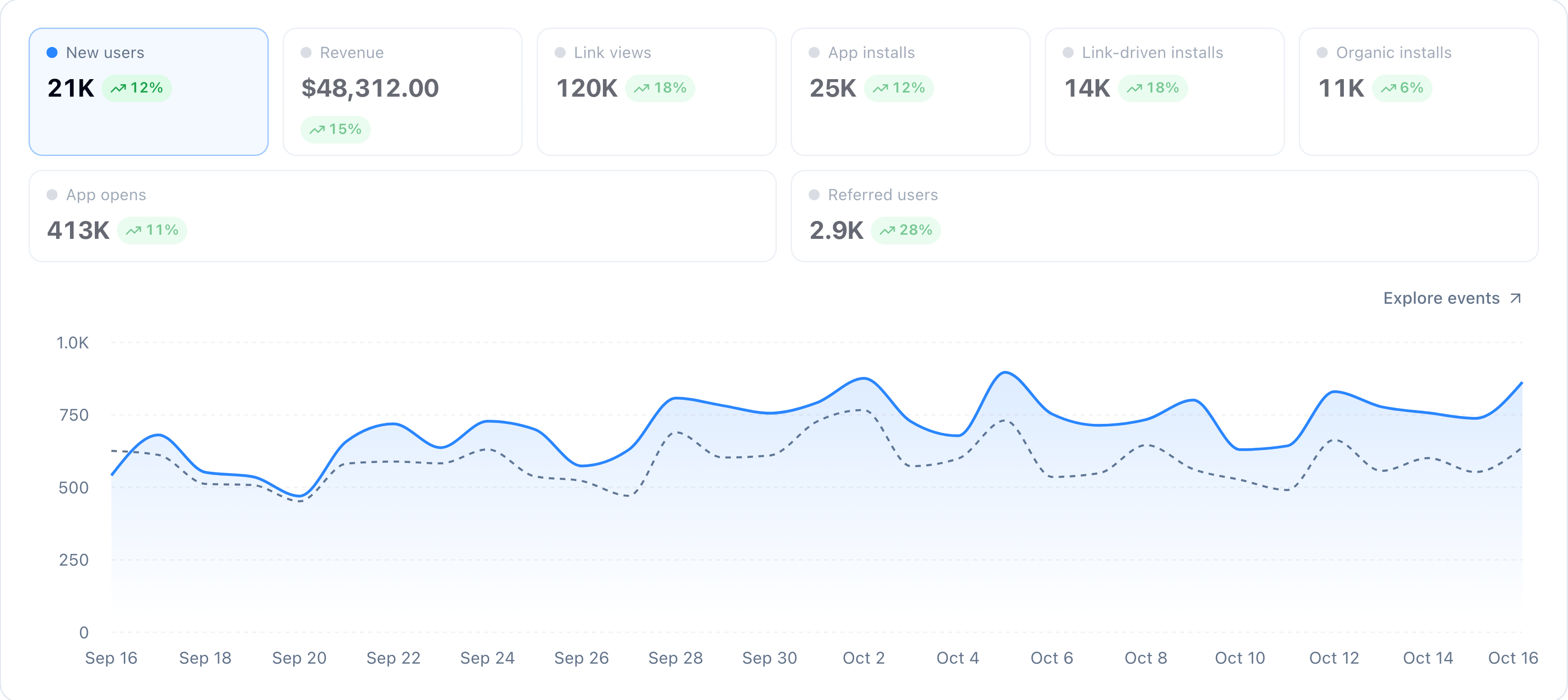
Installs, opens and revenue on one screen.
New users, link-driven and organic installs, and revenue, against the previous period.
Real grovs screen, sample data.
Feature by feature.
From AppsFlyer's public documentation and pricing pages. Spotted something out of date? Tell us and we'll fix it.
AppsFlyer- 1
Events written to your own database. AppsFlyer Data Locker, a paid add-on, sends raw data in batches to storage you own (S3, GCS, BigQuery, Snowflake), not into your own database.
Partial: some of it, with limits. Export: you can get the data out, but it isn't written to your database as it happens.
Last checked 16 October 2026
Pricing, side by side.
AppsFlyer's list prices, as published. The estimate shows what companies report paying, from public contract data.
grovs
Flat yearly price, by monthly active users
- Free
- $0, up to 10K MAU
- Growth
- $2,500 a year up to 250K MAU, $5,000 up to 500K
- Scale
- $12,000 a year, up to 1M MAU
- Enterprise and self-hosted
- Flat yearly licence, unlimited users and events
Source: grovs.io/pricing, October 2026
AppsFlyer
Per attributed conversion
- Zero
- Free, owned media only, not paid campaigns
- Growth
- $0.07 per conversion, 12K free in year one
- Enterprise
- Quote
What customers actually pay · estimate
$88,500 a year
Median of 130 contracts, range $13K to $248K. Source: vendr.com/buyer-guides/appsflyer
Source: appsflyer.com/pricing, October 2026
Which one fits.
AppsFlyer is good at what it does. Here is an honest split.
Choose AppsFlyer if- Most of your growth is paid user acquisition across many ad networks.
- You need fraud protection and ad network postbacks at scale.
- Your users come through channels you own: email, SMS, QR, your website.
- User data can’t be shared with ad networks or leave your cloud.
- You want links, analytics and messaging in one SDK.
Link migration built in
Moving from AppsFlyer.
grovs can take over your AppsFlyer link domain.
Stays with AppsFlyer
- Historical reports (export them first)
- Paid-ad attribution, if you buy ads
You'll need
- A paid grovs plan
- A custom subdomain you control
- A custom OneLink domain, not *.onelink.me
- AppsFlyer's OneLink Data API, a paid entitlement on their side
Moves to grovs
Every existing link
On your custom domain, recreated in grovs the first time it's opened
Link behaviour
The screen each link opens, and its fallbacks
Your branded domain
With its Apple and Android association files
Going back: Until you remove the migration, you can point the CNAME back to AppsFlyer.
The steps
- 1Your team
Ship an app build that knows the old domain
Add the grovs SDK.
Your teamHow it works
On iOS, add applinks:your-old-domain to Associated Domains; on Android, add the SHA-256 fingerprint to assetlinks.json. Ship it and let users update before you move DNS, because grovs replaces AppsFlyer's Apple and Android association files.
- 2Your team
Connect your account
In grovs, open Link Behaviour → Domain → Migrate from another platform.
Your teamHow it works
Choose AppsFlyer, enter your OneLink ID and V2.0 API token, and the old hostname.
- 3grovs
Test before anything moves
The Test button checks your AppsFlyer credentials.
grovsHow it works
Nothing changes for your users yet.
- 4Your team
Move DNS
Add the ownership TXT record if asked, then the SSL TXT record, then the CNAME that points the domain at grovs.
Your teamHow it works
On Cloudflare, set the CNAME to DNS only. Traffic moves only at this step.
- 5grovs
Old links resolve on first open
Each old link is looked up once, recreated in grovs and cached.
grovsHow it works
New links are created in grovs.
- 6Your team
Remove the old SDK
When traffic runs through grovs, take the AppsFlyer SDK out in a later release.
Your team
Plan the move with an engineer.
A call with an engineer who has done it before. You leave with a plan, not a sales pitch.
What the call covers
- Your current setup: SDKs, link domains, events and campaigns
- What moves, what you'd keep, and in what order
- Anything that needs an app release, so you can plan it
- A written plan afterwards, with the steps and who does each
Questions, answered.
Something else? Talk to an engineer.
Can grovs replace AppsFlyer?
For the channels you own (email, SMS, QR, web and referrals), yes. If most of your growth is paid ads across many networks, AppsFlyer's ad network integrations are something grovs doesn't do, and many teams keep an MMP for that.
What moves over from AppsFlyer?
Your links. grovs takes over your AppsFlyer link domain and recreates each old link the first time it's opened. Historical reports stay in AppsFlyer.
Can we run grovs and AppsFlyer side by side?
Yes. Both SDKs can run in the same app while you move, so you can compare numbers before switching anything off.
How long does it take to move?
It depends mostly on your app release cycle: anything that touches links or push needs a new build, and users need to update before you switch. The migration plan above lists which steps need a release.
How does pricing compare with AppsFlyer?
grovs is free up to 10K monthly users, then a flat yearly price: $2,500 up to 250K and $12,000 up to 1M. AppsFlyer's pricing is per attributed install or conversion.
Where does our data live?
On grovs Cloud, in the EU. Self-hosted, in your own cloud or data centre, in databases you run. grovs staff have no access to self-hosted data.
Other comparisons.
All comparisons
grovs vs Adjust
Adjust reports to ad networks. grovs keeps the data with you.
Read the comparison
grovs vs Singular
Singular joins ad spend to installs. grovs joins links to everything after.
Read the comparison
grovs vs Kochava
Kochava measures paid media. grovs owns the whole journey, in your cloud.
Read the comparisonYour first link, live this afternoon.
Install the SDK, connect your domain and send a link that opens the right screen. Start free on grovs Cloud, or run the same stack in your own.
Compare plans$0up to 10K monthly users
- Sign up and add the SDK
- Your first link live the same day
- Flat yearly price as you grow
Flat licencea year, in your cloud, no metering
- AWS, Azure, GCP or your data center
- Deployment help from our engineers
- Your SSO, your database, your rules