Compare / Push and messaging
Pushwoosh prices per active user in its cloud. grovs runs in yours at a flat rate.
Pushwoosh is a messaging platform for push, in-app, email, SMS and messenger apps, with journeys, run in Pushwoosh's cloud. grovs covers push, in-app and journeys, and adds deferred deep links, attribution and purchase validation on your own servers.
Checked against Pushwoosh's public docs and pricing · 16 October 2026
grovs
Links, analytics, engagement, revenue, data
- Built for
- The channels you own, end to end
- Runs in
- Your cloud, or grovs Cloud
- Ad attribution
- Not an MMP
- Pricing
- Flat yearly
Pushwoosh
Push and messaging
- Built for
- Push campaigns
- Runs in
- Pushwoosh's cloud
- Ad attribution
- Not an MMP
- Pricing
- Free to 1K MAU, then $7 to $13 per 1,000 MAU
What Pushwoosh is
Push first.
Sends push to your users, usually with in-app, email or SMS added on.
- Built for
- Push campaigns
- Reports
- Delivery, opens and clicks per message
- Data goes to
- The vendor's cloud
- Doesn't do
- Hosted or deferred deep links, self-hosting
The differences, in short.
Links that survive the install
grovs has deferred deep links, smart banners and QR codes. Pushwoosh deep links open a screen from a push; they don't carry context through an install.
Your cloud, not a vendor's
grovs runs on your own servers. Pushwoosh runs on its own hardware; its private cloud option on custom plans is still hosted by Pushwoosh.
Flat, not per user
grovs is free to 10K monthly users, then a flat yearly price. Pushwoosh charges $7 to $13 per 1,000 MAU beyond the first 1,000.
What each one has that the other doesn't.
No tool does everything. Here's the honest list, both ways.
Pushwoosh has, grovs doesn't
- Email, SMS and WhatsApp sending
- Telegram, LINE and Kakao Talk channels
- Web push
- An AI marketing copilot (ManyMoneyAI)
grovs has, Pushwoosh doesn't
- Deep links and deferred deep links
- Smart banners and QR codes
- Owned-channel attribution
- App Store and Google Play purchase validation
- Self-hosted in your cloud
- Open-source core
In the product
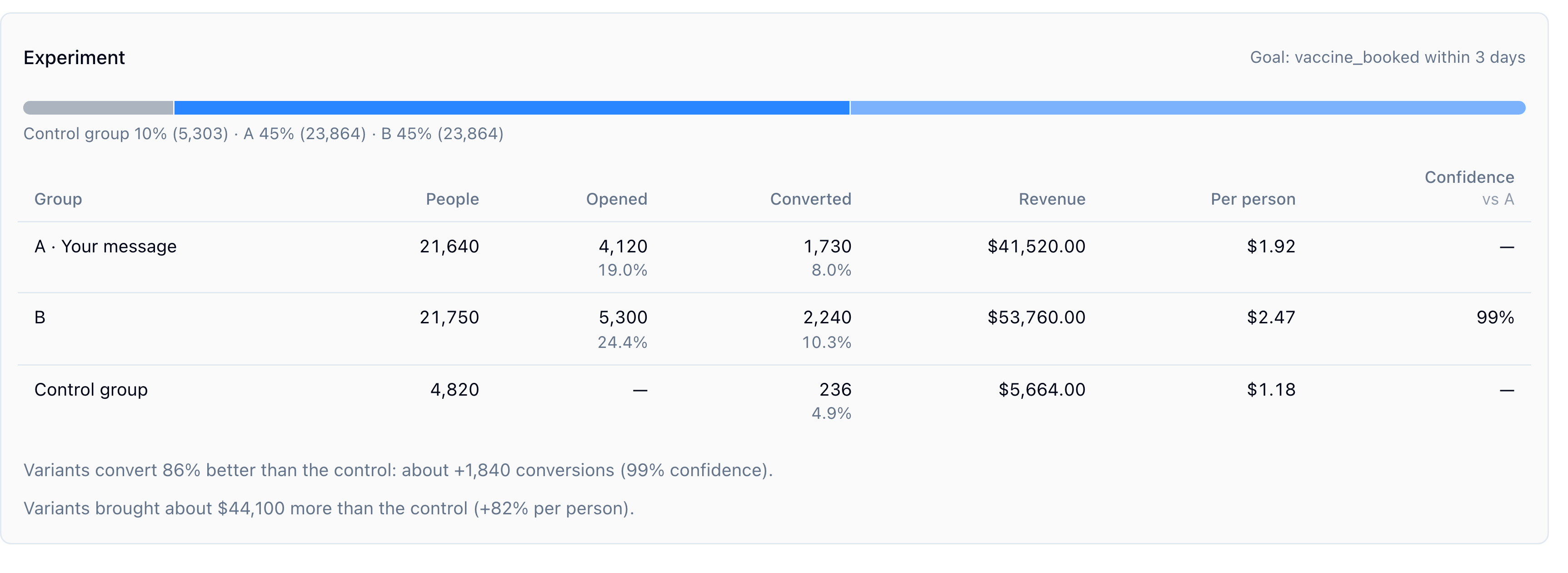
Every push measured in revenue.
Variants against a control group: conversions, revenue per person and confidence.
Real grovs screen, sample data.
Feature by feature.
From Pushwoosh's public documentation and pricing pages. Spotted something out of date? Tell us and we'll fix it.
Pushwoosh- 1
Email and SMS sending. Email, SMS and WhatsApp come with the Omnichannel plan; the Push only plan covers push, in-app and web push.
- 2
Events written to your own database. Pushwoosh streams message events to BigQuery, can write rows to Snowflake from a journey, and offers CSV downloads.
Partial: some of it, with limits. Export: you can get the data out, but it isn't written to your database as it happens.
Last checked 16 October 2026
Pricing, side by side.
Pushwoosh's list prices, as published. The estimate shows what companies report paying, from public contract data.
grovs
Flat yearly price, by monthly active users
- Free
- $0, up to 10K MAU
- Growth
- $2,500 a year up to 250K MAU, $5,000 up to 500K
- Scale
- $12,000 a year, up to 1M MAU
- Enterprise and self-hosted
- Flat yearly licence, unlimited users and events
Source: grovs.io/pricing, October 2026
Pushwoosh
By monthly active users
- Free
- $0 up to 1,000 MAU
- Push only
- $7 per 1,000 MAU (offer to 31 Dec)
- Omnichannel
- $13 per 1,000 MAU
- Email only
- $5 per 1,000 recipients
- Custom
- Quote, above $3,000 a month
Source: pushwoosh.com/pricing, October 2026
Which one fits.
Pushwoosh is good at what it does. Here is an honest split.
Choose Pushwoosh if- You want WhatsApp, Telegram, LINE or Kakao Talk next to push and email.
- You want a free tier and pay-as-you-go monthly billing.
- Deferred deep links matter to how you acquire users.
- Your data has to stay on servers you run, not a vendor's.
- You want a flat yearly price that doesn't grow with every active user.
Migration plan
Moving from Pushwoosh.
Your events, users and journeys move with the SDK.
Stays with Pushwoosh
- Historical data (export it first)
- Email and SMS sending
You'll need
- An app release with the grovs SDK
Moves to grovs
Events and user traits
The same events and traits, from the day the SDK goes live
Segments
Rebuilt from those events, in your own database
Push audience
Devices register for push as users update to the new release
Journeys and in-app messages
Rebuilt one at a time, each checked against a control group
Going back: Nothing to roll back: both run side by side until you remove the old SDK.
The steps
- 1Your team
Add the grovs SDK next to it
Send the same events and user traits to both while you move.
Your team - 2Your team
Rebuild your segments
Recreate the audiences your campaigns use, from events in your own database.
Your team - 3Your team
Let push tokens build up
The grovs SDK registers each device for push when the app opens with the new release.
Your team - 4Together
Move journeys one at a time
Start with one high-volume journey, run it against a control group, compare results, then move the next.
Together - 5Your team
Keep email where it is
If you send email or SMS through Pushwoosh, keep a sending provider for that.
Your team
Plan the move with an engineer.
A call with an engineer who has done it before. You leave with a plan, not a sales pitch.
What the call covers
- Your current setup: SDKs, link domains, events and campaigns
- What moves, what you'd keep, and in what order
- Anything that needs an app release, so you can plan it
- A written plan afterwards, with the steps and who does each
Questions, answered.
Something else? Talk to an engineer.
Can grovs replace Pushwoosh?
For most teams, yes. Check the table above for the features you rely on; where Pushwoosh has something grovs doesn't, it's marked.
What moves over from Pushwoosh?
Your tracking moves with the SDK, and you rebuild the reports and campaigns you use. History stays in Pushwoosh; export it if you need it.
Can we run grovs and Pushwoosh side by side?
Yes. Both SDKs can run in the same app while you move, so you can compare numbers before switching anything off.
How long does it take to move?
It depends mostly on your app release cycle: anything that touches links or push needs a new build, and users need to update before you switch. The migration plan above lists which steps need a release.
How does pricing compare with Pushwoosh?
grovs is free up to 10K monthly users, then a flat yearly price: $2,500 up to 250K and $12,000 up to 1M. Pushwoosh's pricing is free to 1k mau, then $7 to $13 per 1,000 mau.
Where does our data live?
On grovs Cloud, in the EU. Self-hosted, in your own cloud or data centre, in databases you run. grovs staff have no access to self-hosted data.
Other comparisons.
All comparisons
grovs vs Airship
Airship runs your app messaging. grovs also owns the link that brings people in.
Read the comparison
grovs vs OneSignal
OneSignal sends the messages. grovs also brings people into the app.
Read the comparison
grovs vs Branch
Branch made deep links popular. grovs lets you run them yourself.
Read the comparisonYour first link, live this afternoon.
Install the SDK, connect your domain and send a link that opens the right screen. Start free on grovs Cloud, or run the same stack in your own.
Compare plans$0up to 10K monthly users
- Sign up and add the SDK
- Your first link live the same day
- Flat yearly price as you grow
Flat licencea year, in your cloud, no metering
- AWS, Azure, GCP or your data center
- Deployment help from our engineers
- Your SSO, your database, your rules